The Last Hiding Place: The critic, the quieter voice, and the triangle inside
Circumstances Are Neutral, Part 3 of 3
This series began with Maya, a composite of many women I’ve worked with, standing in the Drama Triangle at work, rewriting her VP’s document at 10:40pm. In the second piece we followed the triangle home, to a Sunday-night kitchen and an unbooked restaurant, and we found the line: below it, who caused this; above it, given this, what do I want to do?Both pieces ended with the same warning. When she finally goes to say the real thing, a voice will get there first.
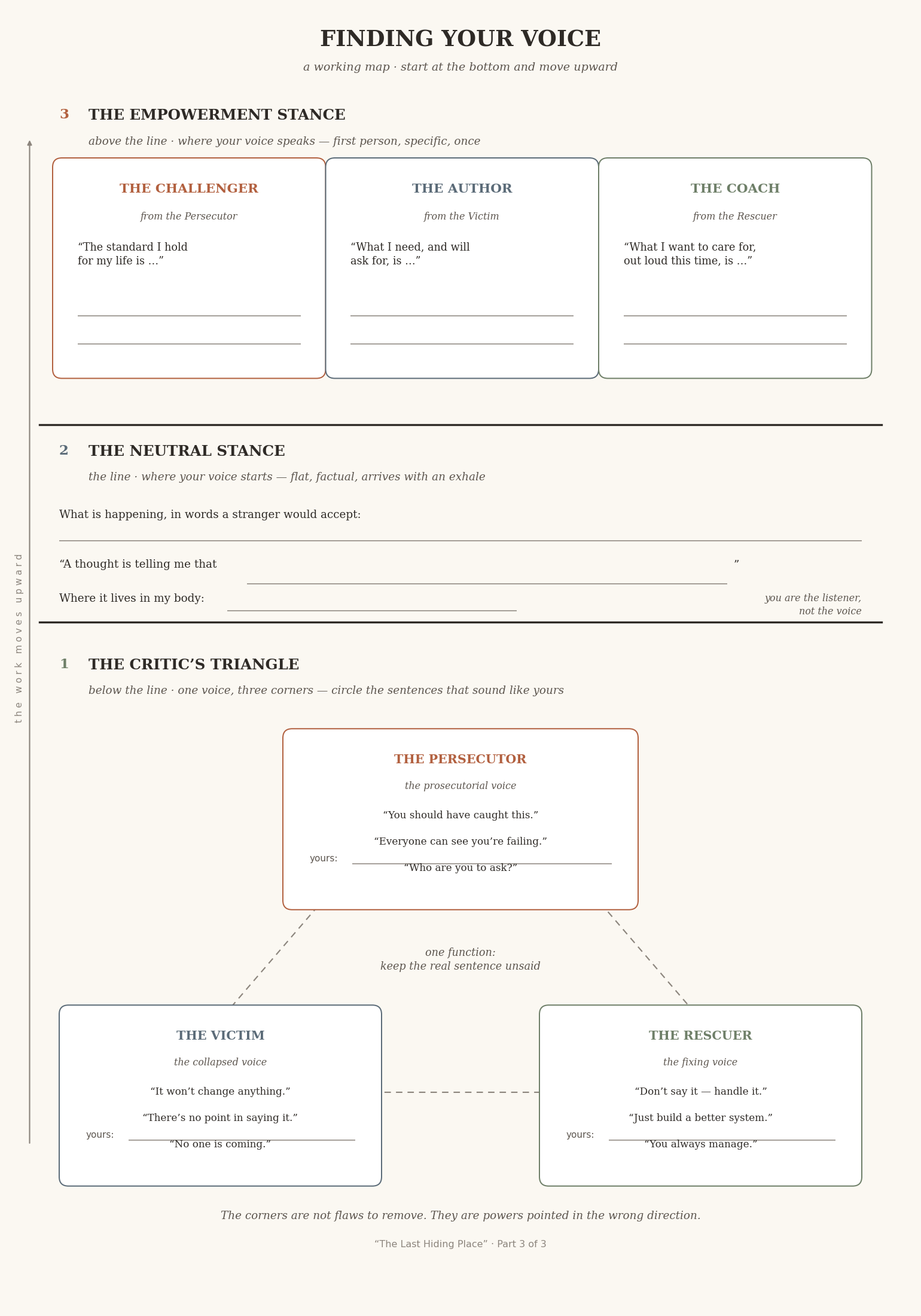
Below is a working diagram and a worksheet.
Thursday, 10:15pm
Maya has decided tonight is the night. The sentence is ready; she has said it to the bathroom mirror twice. I’ve been carrying the logistics of our life for a long time, and I’m tired in a way that’s hard to admit. I want to redraw who carries what.
Daniel is downstairs. She gets as far as the top of the stairs, and the inner voice arrives.
You sound needy. You chose this life — every part of it. He works hard too; this will just hurt him. And honestly, if you can’t handle a household calendar, what does that say about how you’re running the company?
She stops on the stairs. And here I want to slow down, the way I would in a session, because something is available in this moment that Maya has never noticed: the voice is familiar. Not just its content — its structure. She has met this voice before. She met it at work, in the corners of a triangle. She met it in her marriage, in the story that arrived faster than thought. The critic is not a new character in this series.
The critic is the triangle — inward. When the pattern runs out of other people, it runs on you. That is its hiding place.
The three voices of the inner critic
Listen again to what the voice said on the stairs, and you can hear all three corners taking turns.
What does that say about how you’re running the company? — that is the Persecutor, inside. In my office I call it the prosecutorial voice: it cross-examines, it generalizes from one data point to your whole character, and it always addresses you as “you,” the way an interrogator would. Its negative cognitions are verdicts: You should have caught this. You’re failing and everyone can see it. Who are you to ask for anything?
You chose this — this will just hurt him — underneath the accusation, that one lands as collapse, and collapse is the Victim, inside. Its cognitions are resignations: It won’t change anything. There’s no point in saying it. I can’t do this anymore, and no one is coming. Clients often mistake this voice for realism or acceptance. It is neither; you can tell because it closes possibilities rather than weighing them.
And then, quietest of the three, the internal Rescuer: Don’t say anything tonight. Build a better system instead. Try the shared calendar again. Handle it as you always do. This is the voice my highest-functioning clients trust most, because it sounds so constructive. But notice what it rescues her from: the conversation. It is the “It’s fine, I’ll just do it” of the inner world, and it has been managing Maya’s needs the way she manages everyone else’s — by absorbing them before they can be spoken.
Three corners, one function: keep the real sentence unsaid.
Worksheet, part one — find your corner.
(The diagram below maps all three, with space to write. Do this part slowly.)
Bring to mind the real thing you have been meaning to say — at home or at work. Now listen for what arrives to stop you, and write down the exact sentence, word for word. Precision matters here; “my inner critic acts up” is a summary, and summaries can’t be worked with.
My sentence: ________________________________________
Now find its corner. Is it a verdict about who you are (Persecutor)? A door closing on possibility (Victim)? A plan to handle things so the conversation never has to happen (Rescuer)? Most people discover they have a home corner — mine, for what it’s worth, is the third.
My corner: ________________________________________
How to answer your inner critic: the neutral stance
Here is what I have learned not to do with that sentence: argue with it. The critic has decades of selectively filed evidence, and it wins debates. The move that works is the same one we practiced in Part 2, now turned inward — the neutral stance. Describe what is happening in words a stranger would accept.
The stranger’s version of Maya on the stairs is this: A woman is standing on a staircase, preparing to ask her husband to share the household load more evenly. A thought is predicting the request will end badly.
That’s all. Not “I’m needy.” Not “this will destroy something.” A woman, a staircase, a request, a prediction. When Maya can say that version, something shifts that is easy to miss and clinically significant: she has stopped speaking as the voice and started speaking about it. The critic says “you are too much.” The neutral stance says “a thought is telling me I am too much.” Those are different speakers. The second one is her.
This is where your own voice starts — not with affirmations, not with fighting back, but with the flat, factual observation that a voice is speaking and you are the one listening to it. The body will tell you which speaker has the floor. The critic runs tight and fast: the clenched jaw, the urgency, the loop. The neutral stance arrives with an exhale. If you cannot find the exhale, you are still inside the voice, and the only task is to describe the scene again, more plainly.
Worksheet, part two — the translation to neutral.
Take your sentence from part one and rewrite it twice.
The stranger’s version of this moment (who, where, doing what): ________________________________________
The reframe of the voice itself — “A thought is telling me that ______” : ________________________________________
Then note where the original sentence lives in your body: ________________________________________
From inner critic to inner wisdom: the empowerment stance
Neutral is the doorway, not the destination. From neutral, a different voice becomes audible — one that was always there, underneath the louder one. In my experience it is unmistakable once you know its signature, and the signature is almost the critic’s photographic negative. The critic is urgent; this voice is unhurried. The critic repeats; this voice says a thing once. The critic deals in verdicts about your character; this voice deals in specifics about the next step. The critic says “you”; this voice tends to say “I.” Clients describe it as quieter but more certain — less like an argument being won and more like something already known, finally admitted.
And here is the finding that changes how my clients relate to their critic: each corner of the internal triangle is this wiser voice, distorted. The transformation we mapped in Part 2 works inside, too.
The internal Persecutor, translated, becomes the challenger — because under every attack there is a standard that matters to you. “What does that say about how you run your company” is the distorted form of “I hold a high standard for my life, and the current arrangement isn’t meeting it.” Same perception. Different speaker.
The internal Victim, translated, becomes the author — because under every collapse there is a need that has gone unspoken so long it stopped believing in words. “It won’t change anything” is the distorted form of “I need this to change, and it matters enough to me that I’m afraid to ask.” The fear is not weakness; it is a measure of the stakes.
The internal Rescuer, translated, becomes the coach — because under all that frantic fixing there is real care, pointed at the wrong target. “Don’t say anything, just build a better system” is the distorted form of “I want to take care of what matters here — including me — and a system is not what’s needed. A sentence is.”
Nothing gets amputated. The standard stays. The care stays. The perceptiveness stays. What changes is the speaker.
Worksheet, part three — your voice in the empowerment stance.
Return one last time to your sentence from part one. Translate it according to its corner.
If it was a verdict: the standard underneath it is — “What I actually hold a standard for is ______”: ________________________________________
If it was a collapse: the need underneath it is — “What I need, and will ask for, is ______”: ________________________________________
If it was a fix: the care underneath it is — “What I want to take care of, out loud this time, is ______”: ________________________________________
Now write the sentence you will actually say, to an actual person, in your own voice — first person, specific, once: ________________________________________
The bottom of the stairs
Maya stands on the staircase long enough to find the exhale. Then she goes down and says the sentence — not perfectly; her voice catches on “tired in a way that’s hard to admit,” which was the true part. Daniel is quiet, and then a little defensive, and then, twenty minutes later, comes back into the kitchen and says, “I didn’t know it had gotten that heavy. Show me the map.”
I won’t tell you it always goes that way. Sometimes the other person needs longer than twenty minutes; occasionally what becomes clear is something harder. What I can tell you, from many years of watching women do this, is that the catastrophe the voice predicted has, in my experience, almost never arrived, and something else almost always does: the discovery that she can be someone who needs, out loud, and remain standing. That discovery is not a communication skill. It is the end of the triangle’s last hiding place.
This series traced one arc: see the triangle (awareness), cross the line (responsibility), and finally, tell the voices apart (your voice). Maya’s story ends here. Yours is at whatever blank line you stopped on. Go back to it.
This week
Complete the three worksheet sections for one real sentence you’ve been holding back. Then say the final version — the first-person one — to the person it belongs to. Once, plainly, without the armor.
If the voice gets to the stairs before you do, you now know its three costumes, and you know the way through: the stranger’s version, the exhale, the translation. Your voice is the quiet one underneath. It has been finishing your sentences correctly for years. Let it say this one.
Click the pdf to download.